Creating an Automotive Keywords List for SEO
Author: Jon Hedges
Jon has 40 years of marketing experience in the automotive aftermarket industry.
Click for LinkedIn profile

Are you trying to create an auto parts keywords list for your SEO and GEO (generative engine optimization, for AI) project? Hedges & Company recommends using our EAST acronym and Google’s E-E-A-T to optimize web pages.
Still, it’s important to know how auto parts keywords play a role. We do extensive testing and experimenting on what works best for SEO and GEO. We also do our own case studies on consumer search patterns and analysis of keywords. Here are some of our best SEO strategies to build out your own auto parts keyword list.
Keywords, sure; don’t overlook topics
Finding the right keywords is important, but don’t forget the topics people are searching for.
Today in the age of AI, topics and answers are many times more important than the right list of keywords. That’s where our EAST content strategy comes into play: EAST stands for Engagement, Answers, Solutions and Topics.
Tips on building your auto parts keywords list:
- Think about topics before you think about keywords.
- The Road to Purchase is sometimes non-linear. You need to be visible for different types of search keywords along the Road to Purchase
- Your auto parts SEO and GEO strategy should include analyzing click through rate (CTR) vs. organic ranking
- There’s a gold mine of auto parts keywords data waiting for you in your Google Search Console account
- Get organized and create a list of search topics
Any auto parts marketing strategy should include an analytical look at keyword search terms. It’s not easy to do and it’s not a set-it-and-forget-it activity. To be really effective, you have to work on SEO and GEO every day.
Look for auto parts keywords with high click through rates

CLICK TO ENLARGE: Our case study on organic position vs. clickthrough rate (CTR).
You probably already know web pages that rank higher have better click through rates (CTRs). But, do you know how much better?
Our analysis of CTR vs. ranking echos many other SEO studies, but we don’t know of a more comprehensive study done specifically on auto parts SEO keywords.
Clickthrough rates for top-ranked keywords
For this case study, we analyzed over 7,000 auto parts keywords for their rankings on Google and compared their CTR.
We found the #1 ranked keywords had a 310% higher click through rate than words that were ranked at #10.
Automotive keywords ranked at #1 have an average CTR of 20.5% but keywords ranked #10 only had an average 5% CTR. There’s a quick drop-off in click through rate from #1 to #2, where the second-ranked keywords have a 16% CTR.
Just going from the second organic position to #1 can improve your CTR an average of 28%. That’s pretty amazing!
Today, position #1 can have more than one meaning. If Google AI Overviews shows results for a search the top position might be AI citations from a website.
Don’t forget technical keyword terms
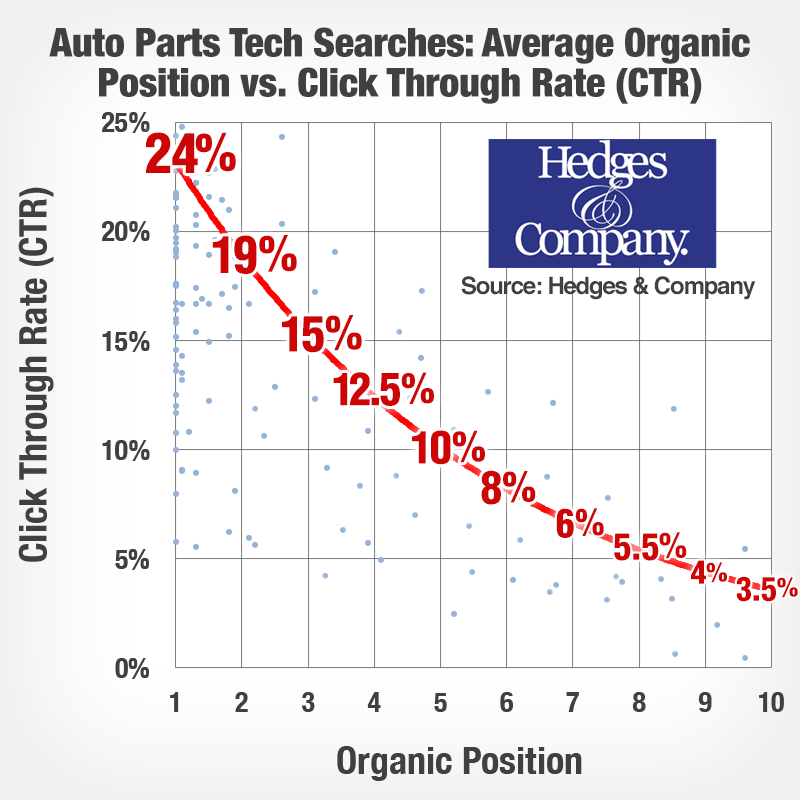
CLICK TO ENLARGE: Average organic ranking vs. CTR for technical searches
Hedges & Company analyzed automotive parts technical searches and their organic rankings vs. CTR.
Technical auto parts searches are terms like “how do I…“, “what does a…“, or searches for specific tech information like a wheel bolt circle diameter or engine firing order.
These can be search terms like “How do I change spark plugs in a 2017 Mustang?” or “What does a reverse rotation turbocharger do?”
The benefit of ranking #1 for technical auto parts searches has an even stronger relationship to CTR. Technical automotive search terms with a #1 ranking had an average click through rate of 24%, even higher than the example in the first graph above.
Top-ranked technical search terms: even higher clickthrough rates
Technical automotive search terms that were ranked #1 had a 585% higher CTR than technical search terms ranked #10.
This is an important strategy: Include automotive technical search terms in your auto parts keyword list.
Click here for a more detailed look at Google search patterns for auto parts and accessories.
Look at your Google Search Console keywords
Here’s the default GSC graph (blurred for privacy) for the past three months with Total Clicks (blue) and Total Impressions (aqua) highlighted. Add Average CTR (green) and Average Position (purple).
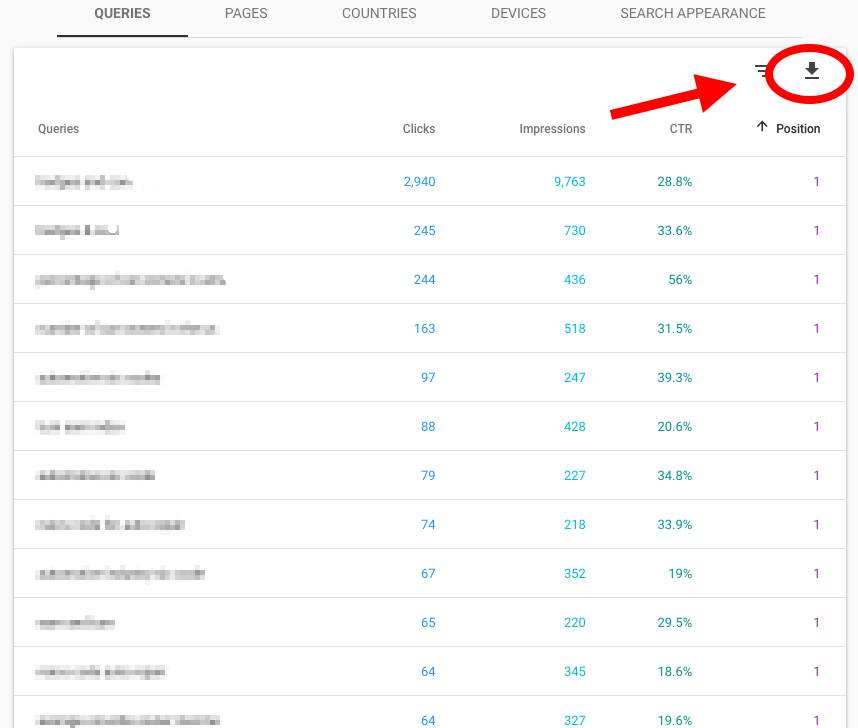 Next, click the download icon as shown at the left (arrow pointing down). This lets you download a file (Google Sheets, .csv or Excel) that you can open and see valuable data for your SEO efforts.
You’ll get all the organic search terms that shoppers clicked on to visit your site, terms your site showed up for whether they resulted in a click or not (impressions), the average position for those search terms and the average click through rate for each search term.
Pro tip: Download this keyword data on a regular basis to track it over time. 
Another pro tip: Connect your Google Search Console account with Ahrefs and with your Google Analytics accounts.
Even another pro tip: Use Google Search Console’s new built-in AI analysis, or better yet, download your keywords and upload them to Gemini, ChatGPT, Claude or Perplexity to dig deeper.
This type of data also lets you create the type of scatter charts that we show above, too, so you can look at your average organic rankings vs click through rate. We made that in Excel using a simple download of data like we’re describing, from Google Search Console.
Search Console used to have a lot of time range limits. Today it’s easy to go back farther than the old default three months but a lot of SEO veterans remember those frustrating old limits.
Of course, this process doesn’t show what your competitors are doing in their SEO strategies – there are some third party SEO tools either free or paid for that type of research – but we really like Google Search Console as a free SEO tool.
As a side note, Google Search Console also helps you monitor your Core Web Vitals. These plan an important role in your organic rankings.
Auto parts keywords: Create a list of topics first
You need to focus and do research to be really effective at marketing your website. It helps to create a list of topics that are important to your SEO efforts.
Or if you use our pro tips above, load your keywords into your favorite AI platform and have it create your list of topics. (Of course, that will show you current topics, not ones you’re working on for the future.)
This organized approach keeps you focused, helps manage your efforts, and makes it easy to track your SEO work over time. You have to have an organized approach to data used for SEO otherwise it’s easy to get overwhelmed and off track.
Remember to write for humans, not Google
And if you’ve been following the latest trends on automotive SEO you already know, topics and related keywords usually beats just looking for keywords. That also helps you stay focused writing content for humans instead of for search engines.
Creating an organized list of topics, and keywords within those topics, allows you to create a structured plan for your auto parts SEO campaign. If you truly want your website to succeed, having a plan will always get you better results than flying blind.
After all, doesn’t data drive everything we do in the automotive aftermarket? Nothing sells well without great data.
Example: Auto repair keywords
If you’re looking for keywords specific to auto repair, think first about topics. What kind of auto repair? What vehicle?
Let’s use engine repair for Honda Civic to start. Appropriate keywords would be fitment-related, like “2016-2021 Honda Civic,” “10th gen Civic,” or “2021 Civic Hatchback.” Keywords would also be part-specific, like “2016 Civic engine,” “2017 1.5L VTEC turbo timing belt,” or “L15B7” (that’s the 1.5 liter turbo engine in a 10th generation Civic; many Asian engines are searched for by engine platform code). Many times people search for symptoms, or to solve problems, like “oil dilution,” a common problem in Civics of that generation (fuel mixing with oil).
Once you have your topics figured out, it’s much easier to come up with specific keywords.
Understanding the Road to Purchase
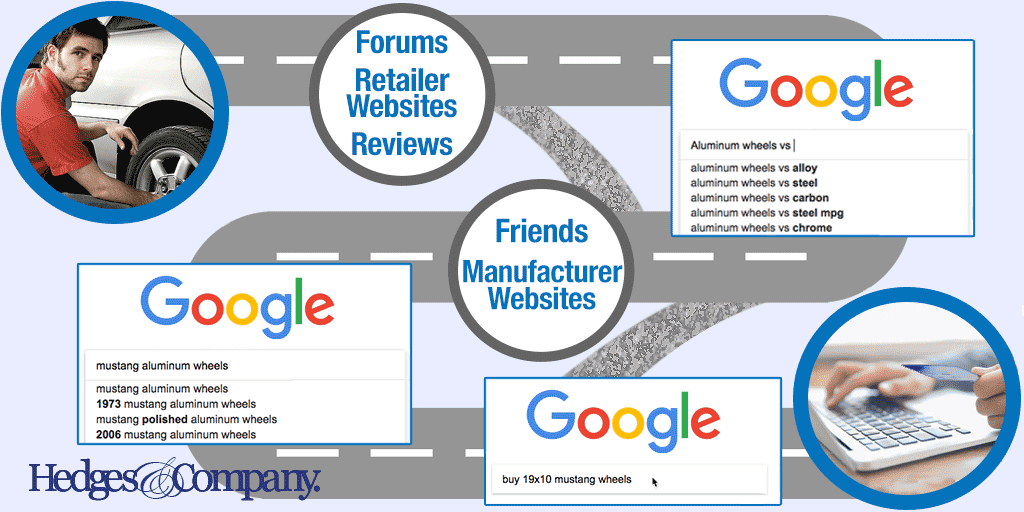
CLICK TO ENLARGE: The consumer’s Road to Purchase (usually called Path to Purchase, but we like cars!).
The auto parts Road to Purchase is a winding one (usually called Path to Purchase but we like cars here). It’s commonly accepted that shoppers take some type of path before purchasing. You should have some idea of what the automotive parts Road to Purchase looks like before starting your auto parts SEO strategy.
The Road to Purchase for car parts can vary a lot, depending on what part you’re optimizing for. For example, when a shopper needs an OEM part, it’s usually because something broke or wore out. It may not be a planned purchase.
But, for a performance car part, an accessory, or something to customize a vehicle, the shopper may have been thinking about that part for weeks, months or even years.
The Road to Purchase for these different kinds of parts can be wildly different, and your auto parts SEO strategy needs to be both adaptable and scalable in order to reach all kinds of potential buyers.
SEO requirements vs. the Road to Purchase
Look at the Road to Purchase and you can see SEO requirements change as a shopper moves along the Road. It may start with interest in a certain part without details. It may involve looking at forums for more ideas. The searches used on Google at this point can be vague and generic.
A car parts shopper may then look at manufacturer websites to verify fitment or see an entire product line. Hedges & Company has done research that shows nearly three out of five of shoppers visit manufacturer websites.
As the shopper travels down the Road to Purchase, the search activity gets more specific with keywords that show high purchase intent, like “where to buy…” or very specific fitment queries.
Frequently asked questions about auto parts keywords
Q: How do I create an auto parts keywords list?
A: Build an auto parts keywords list by analyzing your product catalog and identifying the parts you sell. Build your auto parts keywords list by combining product names with vehicle makes, models, and years. Include variations like brand names, part numbers, OEM vs aftermarket terminology, and common misspellings. Use keyword research tools to find related searches and question-based queries.
Q: What’s the difference between short-tail and long-tail automotive keywords?
A: Short-tail automotive keywords are broad, one-to-two-word terms like “brake pads” or “spark plugs” that have high search volume but intense competition. Long-tail automotive keywords are more specific phrases like “ceramic brake pads for 2018 Ford F-150” that have lower search volume but higher conversion rates. Long-tail keywords typically indicate stronger purchase intent because searchers know exactly what they need.
Q: Should I target general automotive keywords or vehicle-specific terms?
A: You should target both. General automotive keywords like “performance air filters” attract broader traffic and work well for category pages. Vehicle-specific keywords like “air filter for 2020 Toyota Camry” capture high-intent shoppers who know their exact fitment needs. The most effective strategy uses general terms for top-level pages and vehicle-specific long-tail keywords for product pages and blog content.
Q: How often should I update my auto parts keywords list?
A: There’s no rule but we’d recommend looking at least once a quarter. SEO professionals look much more frequently. The reason to revisit your keywords list often is because Google algorithms change, competitors change, products on your website changes, and shopping or search behavior changes. Monitor your keyword performance monthly through analytics, add new terms when appropriate.