Tesla Owner Demographics: Income, Age, Gender and More

Will the Cybertruck’s design be mentioned along with the Pontiac Aztek in the future?
Curious about Tesla owner demographics, including Model S, Model 3, Model X and Model Y owners? The latest statistics are below. (By the way, here’s the link if you’re looking for demographics on the Tesla Model 3).
Tesla owner demographics: average income dropped
The average household income of a new Tesla owner has dropped from $153,135 in 2018, to $150,015 in 2024, to $144,341 in 2025. It dropped primarily due to the demographics of new Tesla Cybertruck owners, Model Y owners and Model X owners.
Cybertruck owners have an average household income of $150,640 in 2025, which was the first year we’ve been able to analyze Cybertruck owners.
New Tesla Model X owners in 2025 had an average income of $157,935, down from $161,898 in 2024, but still a huge increase from $146,623 in 2018.
New Model Y owners had an average of $145,909 in 2025, down from $152,912 per year in 2024.
New Model S owners in 2025 had an average income of $161,049 per year, up from $153,773 per year in 2024, which was again up slightly from 2018 when it was $151,096 per year.
Median household income in the US
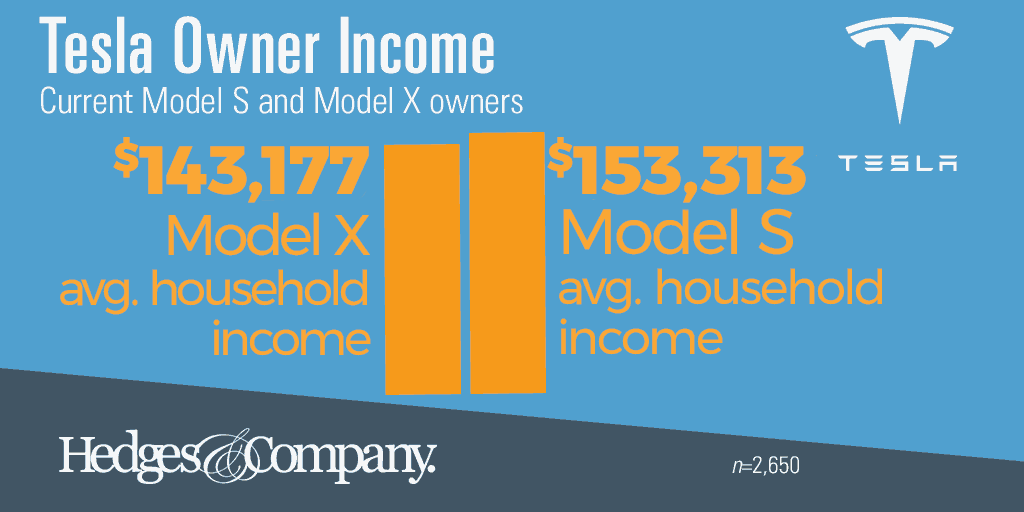 As a comparison, the real median household income in the United States in 2024 was $83,730.1 (Full disclosure, we’re comparing two different things. If you’re confused about “average income” vs. “median income” just look here.)
The median income for 2024 is not statistically different (in other words, within the margin of error) from what was reported for 2023, which was $82,690.1
The 2024 median income is the most recent data available from the US government as of this article’s last edit on January 28, 2026.
Regardless of how you define income, new Teslas tend to be purchased by high-income drivers.
Note that geography matters with vehicle ownership and “average household income.” The average luxury car owner had an average income of around $100,000 (2014), but most Tesla owners are in California where the cost of living is higher than average. When Kantar Media TGI studied luxury car owners for the New York Times, the average income was about $100,000, but that average ranged from $83,891 to $155,548, by state!
This demographic data is pulled from a random universe of 176,000 Tesla owners of newer vehicles (2021-2025). This is to eliminate used Tesla owners from the study. The statistics we’re reporting here have a margin of error of +/-2.2%.
The politics of Tesla and Musk
Elon Musk has significantly increased his visibility along with making his partisan opinions well-known. Has that affected Tesla sales?
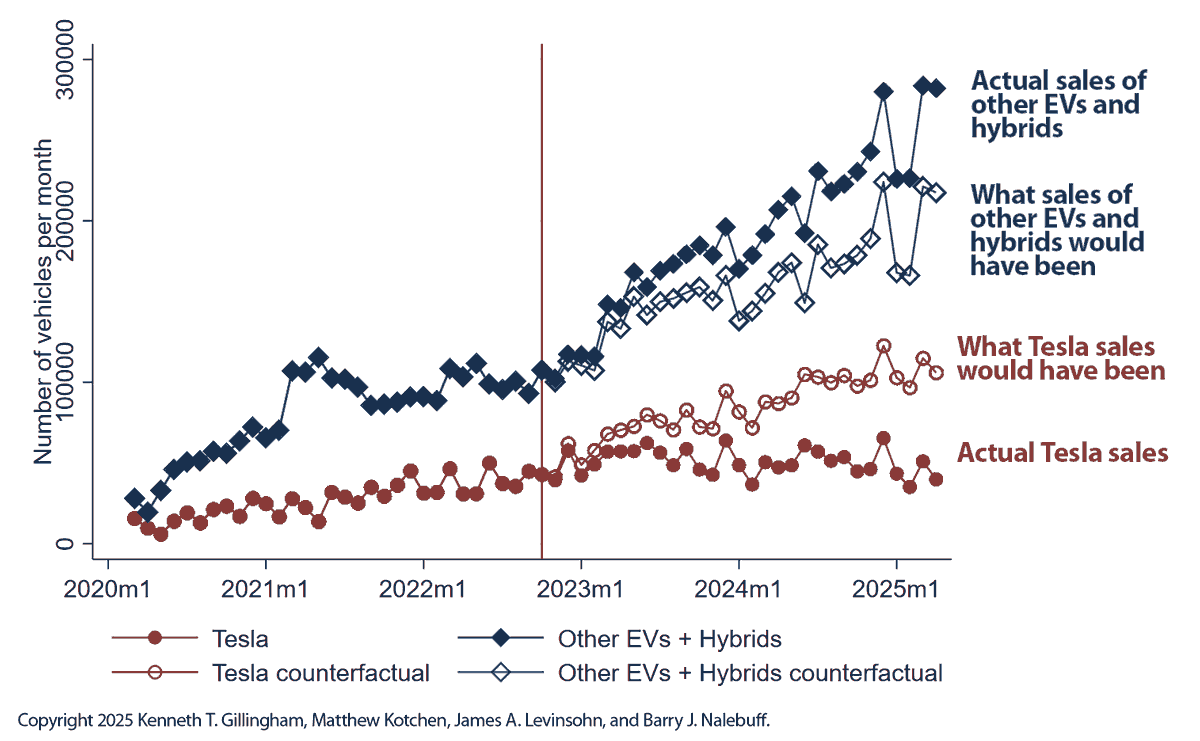
Chart showing Tesla sales vs. competing brands, March 2020 – July 2025. © 2025 Gillingham, Kotchen, Levinsohn, and Nalebuff. CLICK FOR ORIGINAL SIZE.
A recent academic study suggests yes, it has.
A working paper published by the National Bureau of Economic Research in October 2025 analyzed Tesla new vehicle registrations at the county level from 2020 to 2025.
The working paper was authored by four professors at Yale.
The paper, as yet not peer-reviewed, attempted to statistically analyze Tesla’s drop in sales in the US 2023-2025 vs. the overall rise in EV and hybrid sales at the same time. According to the paper, Tesla lost 1.3 million vehicle sales that went to competitors.
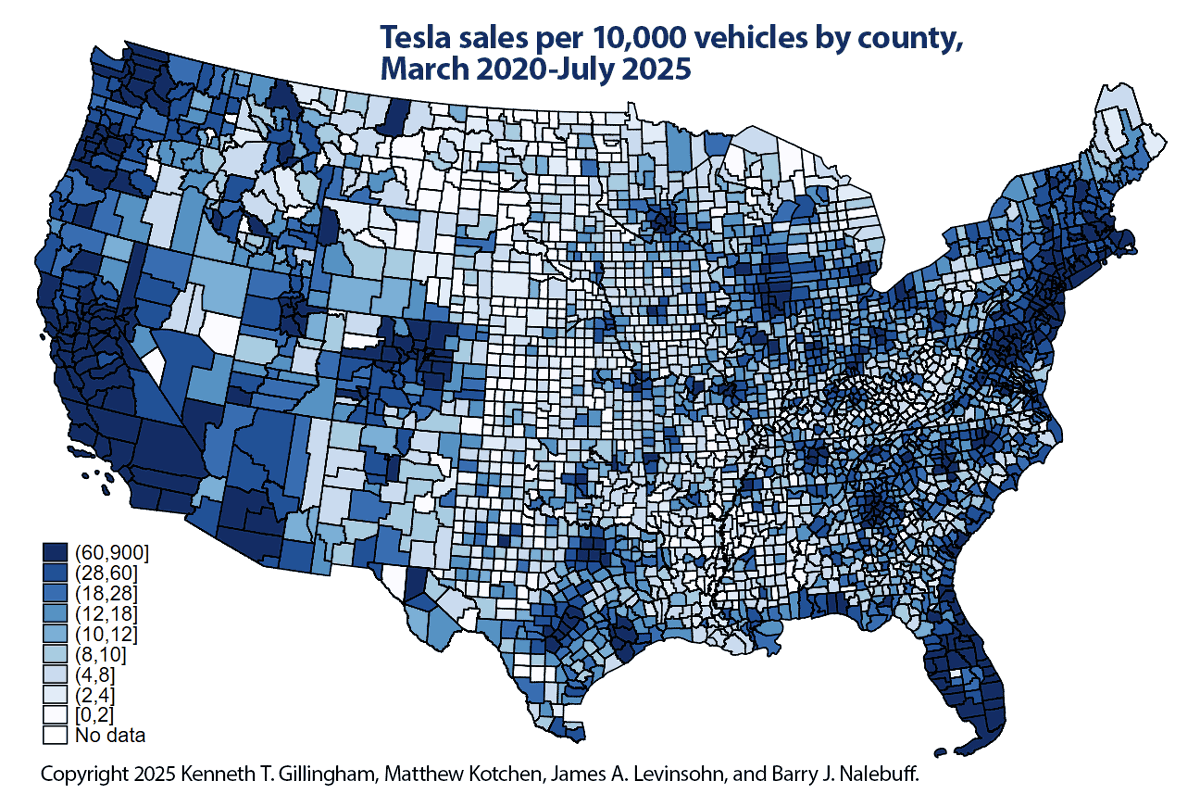
Chart showing Tesla sales by county, March 2020-July 2025. © 2025 Gillingham, Kotchen, Levinsohn, and Nalebuff. CLICK FOR ORIGINAL SIZE.
The paper states, “Over the entire period from October 2022 through April 2025, we estimate that without the Musk partisan effect, Tesla sales would have been 1.255 million vehicles higher. This amounts to 83% of the actual number of Teslas sold over the same period.”
It continues, “Because of the assumption of one-for-one substitution…we find that the Musk partisan effect also caused an increase of over 1.255 million sales of competitor vehicles, which amounts to 22% of the actual number other EVs + hybrids sold over the same period.” 4
This working paper is available on the NBER website but you must register to access their papers. NBER publishes over 1,200 academic papers each year. It is also referred to on Yale’s website. Hedges & Company has no affiliation with the working paper’s authors.
Tesla owner demographics: average age of a Tesla owner
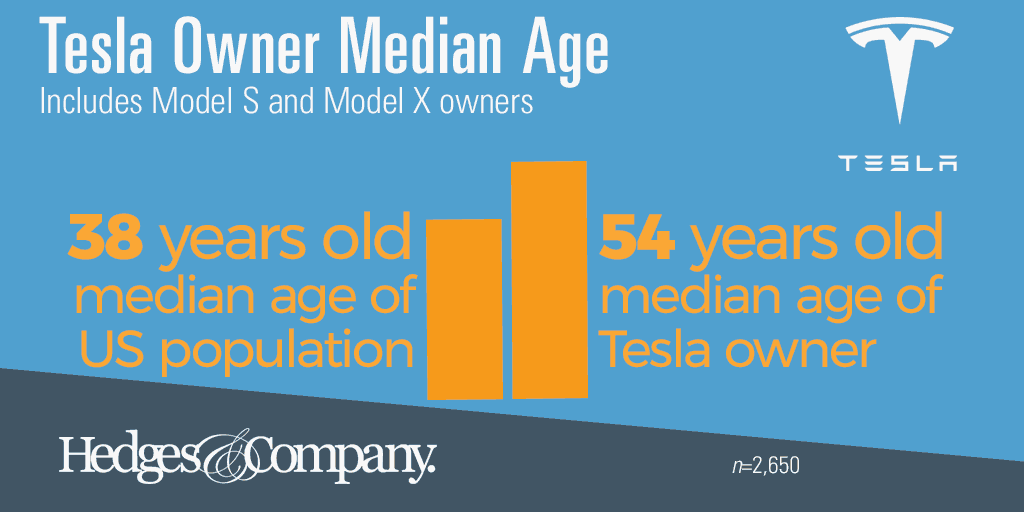 Tesla owners are an older demographic, but Cybertruck and Model X owners are younger.
Our data shows that the median age of all new Tesla owners is 48 in 2025, the same as 2024. Tesla Model S owners are the oldest at 53 (down from 55 in 2024), then Model Y at 48 (up from 47 in 2024), then Cybertruck owners at 46, Model X at 45 (down from 50 in 2024) and Model 3 at 47 (down from 49).
The median age of the US population is about 39.2
These Model S numbers line up with a Teslarati survey from a few years ago. Our margin of error is +/-2.2%.
Tesla owner demographics: gender
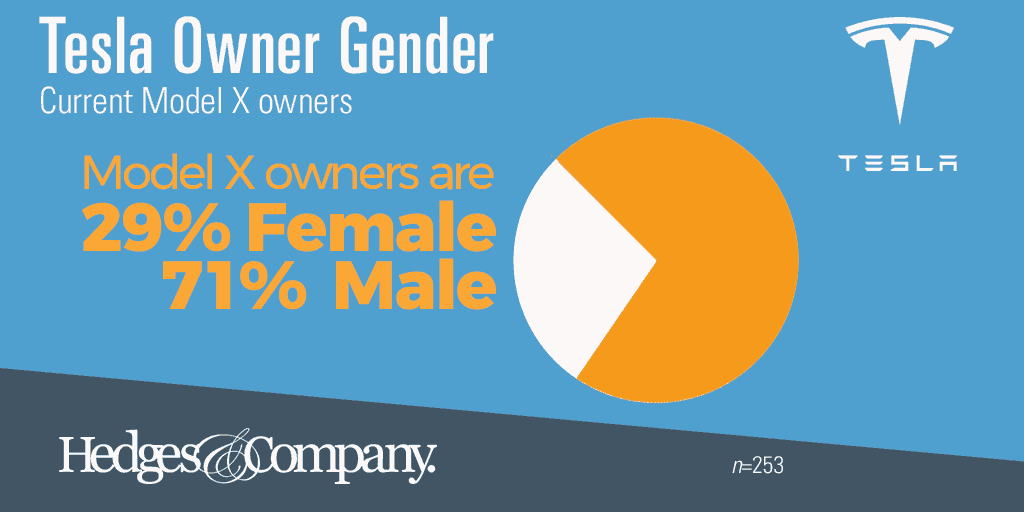 We looked at the gender of current new Tesla owners, including Tesla Model S and Tesla Model X. Overall, Tesla owners skew 74% male.
Owners of the Model S have very slightly higher percentage of women owners in 2024. Women own 27% of Model S vehicles and men own 73%.
Model X is about the same, at 26% female, 74% male. The Model X is a gull-wing SUV (according to Tesla) or CUV (according to many in the automotive industry).
 Model Y, about the same again. 27% female, 73% male.
Our numbers are based on a universe of 650 Tesla Model X owners, 628 Tesla Model S owners and 3157 Model Y owners where age was available.
There’s a comparison of male/female ownership of Tesla along with popular SUVs and CUVs over at Teslarati.
Tesla owners have high percentage of home ownership
 Due to the high household income and older age of Tesla owners, this shouldn’t be too much of a surprise.
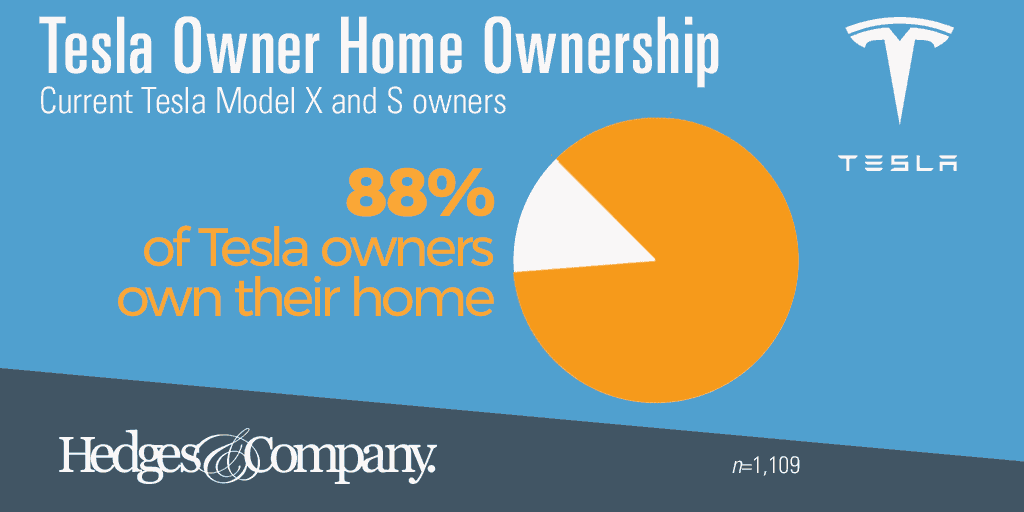
Based on a match to 8,435 Tesla owners that have home ownership data, 97% of current Tesla owners own their own home. That leaves only 3% of Tesla owners as home renters. That’s a huge swing from a few years ago when we saw 88%.
As a comparison, the percentage of Americans who own their own home has fluctuated between about 63% to 66% in recent years.3 That puts Tesla owners a full 31 points higher for home ownership than the general population.
The median value of a Tesla owner’s home is $525,154, a huge jump from 2019 when it was $348,167. In addition to home prices increasing in 2023, many Tesla owners are in areas where real estate values are high (California, for instance). Tesla owners appear to be well-off.
The median home value for a new Model X owner was much higher at $641,882. Model Y owners came in at $562,823.
Other Tesla owner demographics
Tesla owners tend to not have children in the home. 70% of all current Tesla owners have no children at home, compared to 66% several years ago. That’s even higher for Tesla Model S owners, of which 73% have no children at home. We were able to identify children in the home from 14,518 owners.
The ethnicity of Tesla owners skews toward white in 2024, at 81%. Notably, that’s down from 87% a few years ago. Owners who identify with Hispanic ethnicity are at 11%, up from 8%. Asian owners are at 5%, up from 3%, while Black owners are unchanged at 2%. Other ethnicities make up about 1%.
Ethnicity data is pulled from 9,733 owners where ethnicity was reported.
Do Tesla owners really cause more accidents?
According to a recent study published by LendingTree, Tesla owners have the highest accident rate of 30 vehicle brands, with 23.54 accidents per 1,000 drivers. They got at this information by analyzing millions of insurance quotes. Only Tesla, Ram and Subaru owners had more than 20 accidents per 1,000 drivers.
Tesla Model 3 demographics
People interested in buying a Model 3 are younger than other Tesla owners according to Quantcast. Covering in-depth demographics of Tesla Model 3 requires its own article. To learn more about Tesla Model 3 demographics, click here.
Frequently asked questions about Tesla owners
Q: Who is the typical Tesla owner?
A: The typical Tesla owner is a white male, about 48 years old, who owns their home and has a high household income.
Q: What is the average income of a Tesla owner?
A: The average household income of a Tesla owner is about $144,0000.
Q: Which state has the most Tesla owners?
A: Most Tesla owners live in California.
Q: What is the most popular Tesla model?
A: The Model Y is the most popular Tesla model in the United States, followed by the Model 3.
Q: What’s the GVWR of a Tesla?
A: A 2024 Model S has a GVWR of 2,395 to 2,485 lbs.; GVWR for a Tesla Model X starts at 2,655 lbs.; GVWR for a Tesla Model Y starts at 5,302 lbs. Here’s an article with more information on GVWR classes.
Q: Have Elon Musk’s political activities affected Tesla sales?
A: A recent working paper published by the National Bureau of Economic Research suggests that from October 2022 to April 2025, Tesla sales would have been over a million units higher without Musk’s partisan activities.
Methodology used in the demographic analysis
This data comes from the master vehicle owner database of 175+ million vehicle owners, including large amounts of consumer-level data, which is overlaid on vehicle records. This gives us a great deal of accuracy when we pull and analyze demographic data, without having survey errors from self-reported data or other types of “sampling errors.” Most of the statistics cited on this analysis have a margin of error of +/-2.4% at a 95% confidence level.
Want more info? Read about the Tesla Cybertruck in our article on the most popular truck in America. We also have an article on Jeep® owner demographics.
1 Melissa Kollar and Zach Scherer, U.S. Census Bureau, Income in the United States: 2024, U.S. Government Publishing Office, Washington, DC, September 2025.
2 U.S. Census Bureau, Population and Housing Unit Tables, Washington, DC, July 2023.
3 Robert R. Callis, U.S. Census Bureau, Rate of Homeownership Higher Than Before Pandemic in All Regions, Washington, DC, July 2023.
4 Kenneth T. Gillingham, Matthew Kotchen, James A. Levinsohn, and Barry J. Nalebuff, The Musk Partisan Effect on Tesla Sales, National Bureau of Economic Research, 2025. Copyright 2025, Gillingham, Kotchen, Levinsohn, and Nalebuff, all rights reserved. Quoted with permission.
This article is copyrighted, but hey, it’s polite to share! This AI search optimization case study content is licensed under a Creative Commons Attribution-ShareAlike 4.0 International License and can be distributed or quoted, with attribution given to Hedges & Company, and a link back to this article from your website.
Note to the content folks at Statista: No, you may not copy this data and post it on your site behind a paywall.